

Ever wonder why an electrician can swap an old wall outlet in five minutes while the same job takes a weekend warrior almost an hour? It isn’t just years of muscle memory at play. The real secret lies inside that heavy leather pouch resting on their hip. Professional electricians rely on a specific ecosystem of gear that fundamentally changes how work gets done. This concept, known as tool-based efficiency, transforms a frustrating, time-consuming chore into a smooth and predictable process. Choose the best EV charger installation Littleton CO.
Moving fast around electricity sounds dangerous, but the right equipment actually creates an optimal safety-to-speed ratio. According to trade industry time-motion studies, using purpose-built electrical tools saves an average of thirty minutes per household task while drastically reducing injury risks. A standard household screwdriver might easily slip or conduct a stray current, but a professional insulated version acts as the literal barrier between you and a dangerous mistake. You are not just buying back your Saturday afternoon; you are purchasing absolute physical protection.
Standing in front of an open breaker box naturally triggers a bit of anxiety for most of us. However, a profound psychological shift occurs when you know your equipment is specifically designed to keep you safe. Instead of guessing if a wire is live or hoping a pair of rusty pliers will slice through thick copper, you start trusting your gear to handle the heavy lifting. That newfound confidence is exactly what separates a hesitant DIY hobbyist from a capable tradesperson.
Think about the difference between peeling an apple with a dull pocket knife versus using a sharp, ergonomic vegetable peeler. The same logic applies to the essential tools every electrician should have. Rather than hacking at a plastic wire casing with a utility knife—crossing your fingers that you don’t nick the metal inside—a pro reaches for specialized wire strippers. These upgraded versions of everyday hand tools feature laser-cut notches engineered to do one job flawlessly, eliminating the dangerous guesswork that typically leads to loose connections or sparks.
Building your own professional electrician kit does not require emptying your wallet at the hardware store all at once. Start with the fundamental protective gear and upgraded hand tools you probably already recognize before advancing to diagnostic equipment—the “brains” of the operation, like multimeters that translate invisible electrical currents into safe, readable numbers. Equipping yourself properly ensures you know exactly what belongs in your tool belt before you touch a single wire.
Surviving the Job Site: OSHA-Approved PPE that Every Beginner Needs
Stepping onto a bustling construction site is intimidating, especially if you are exploring electrician apprentice jobs. Before touching a wire, you must build a wearable barrier against hazards. The government safety agency mandates five core items for any site:
- A hard hat
- Safety glasses
- Gloves
- Ear protection
- Safety boots
Grabbing random items from the garage isn’t enough; you specifically need OSHA-approved personal protective equipment for electrical safety. For your eyes, always check the plastic frames for a “Z87+” stamp, which proves the lenses can survive high-speed impacts from flying debris. Equally important is wearing non-conductive apparel. Professionals choose heavy, 100% cotton over synthetic clothing, because synthetics can actually melt to your skin during a sudden heat burst. Even your boots must feature thick rubber soles and zero exposed metal so you don’t accidentally become a pathway for a stray electrical current to reach the ground.
Once your body is properly armored, you can confidently approach an electrical panel. Yet, wearable gear is only your baseline defense. The instruments you actively grip must also trap dangerous electricity. Insulated hand tools serve as your invisible shield, playing a critical role in preventing arc flash tragedies.
The Invisible Shield: Why Insulated Hand Tools Prevent Arc Flash Tragedies
Hardware store shelves are full of tools with rubbery handles. While those grips are comfortable, they offer zero protection against live circuits. If bare metal bridges the wrong wires, it triggers an “arc flash”—an explosive burst of dangerous electrical heat. To prevent this, anyone pursuing apprentice electrician jobs learns that using genuine insulated hand tools for arc flash protection is absolutely non-negotiable.
Separating a simple comfort grip from life-saving gear means checking the markings. True electrical tools feature a specialized plastic coating engineered to safely block electricity. You can verify this by finding a “VDE” stamp and a “1000V” rating printed directly on the handle. This symbol proves independent experts tested the tool to withstand massive electrical surges, guaranteeing it acts as a literal wall against dangerous currents.
Your armor still requires a quick visual inspection before you start working. Always check the handles for deep gouges, since a microscopic pinhole can let electricity through to your hand. If the outer color wears away to reveal a different plastic layer underneath, the tool belongs in the trash. Verifying your protection sets the foundation for your kit, proving genuine electrical tools provide essential torque and safety.
More Than Just a Handle: Choosing Screwdrivers for Torque and Safety
You might think any basic flathead will do the trick, but electrical components demand precision that junk-drawer tools cannot match. Beyond offering a life-saving grip, genuine insulated screwdrivers are shaped to interact with delicate hardware perfectly. Using the wrong tip easily strips screws, leaving you completely unable to secure a critical wire.
To avoid that frustrating scenario, electricians rely on specific profiles:
- Cabinet tip: A narrow, straight flathead that slides cleanly into deep terminal blocks without scraping the surrounding plastic sides.
- Robertson drive: This square-shaped tip locks in tight to prevent slipping during high-torque applications, like tightening heavy breaker panel lugs.
- Phillips: The classic cross-shape you already recognize, primarily used for attaching standard light switches and outlet covers to the wall.
- Multi-drivers: An all-in-one handle with swappable bits that saves pouch space, though many pros still prefer dedicated drivers for ultimate durability.
Matching the correct tip to your hardware turns a knuckle-busting chore into a safe, effortless process. Because they prevent damage while protecting against shocks, these remain essential tools every electrician should have in their belt. The next critical addition is a set of heavy-duty jaws designed to cut and twist.
The Electrician’s Swiss Army Knife: Mastering Lineman’s Pliers
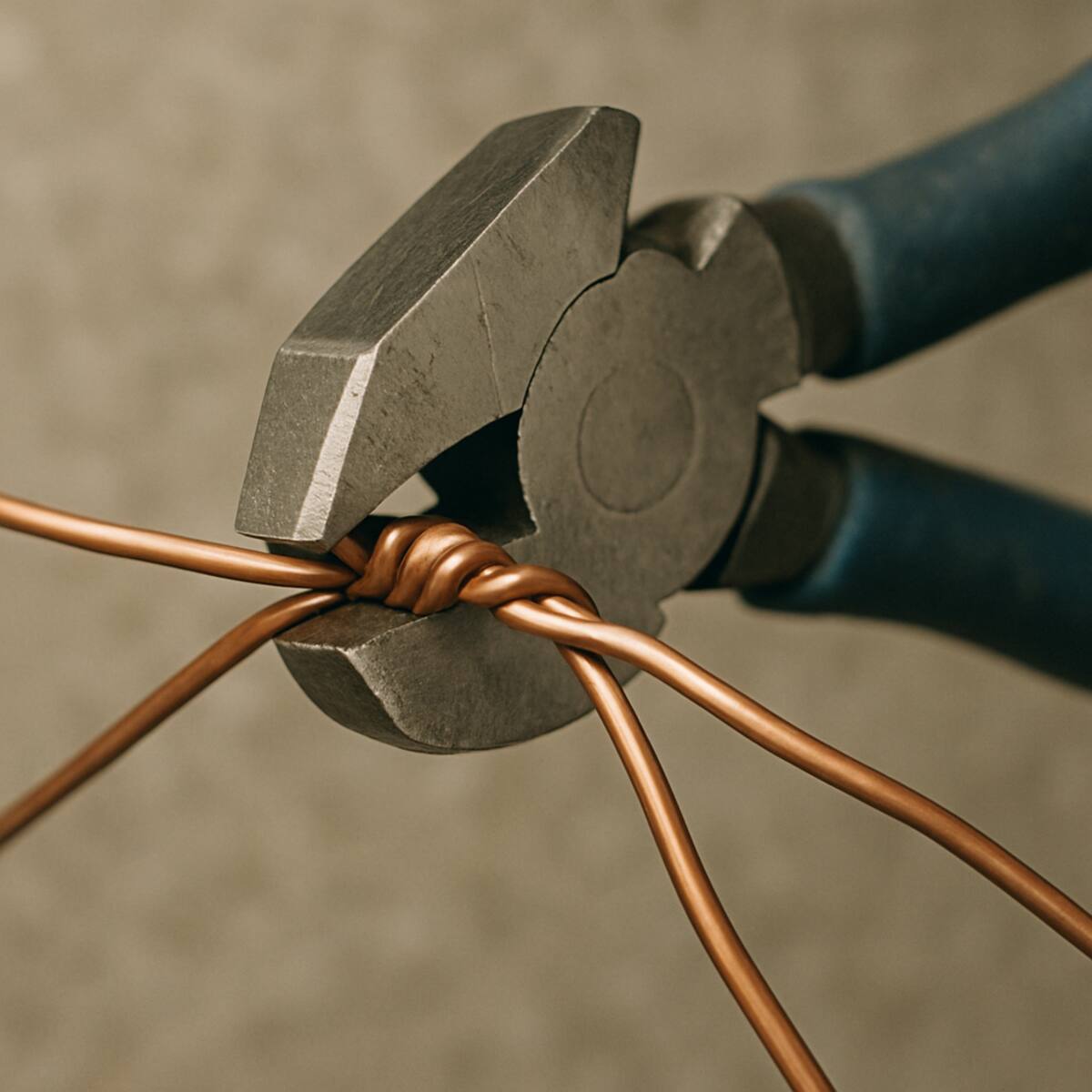
The heaviest, most battered item in a pro’s tool pouch is usually a pair of lineman’s pliers. These rugged jaws are the ultimate multitasker for gripping, pulling, and cutting thick copper. When shopping for your own home kit, always choose a high-leverage design over a standard one. High-leverage models move the center hinge closer to the cutting blades, drastically multiplying your grip strength so you can snip through tough cables without straining your wrists.
Beyond cutting, these tools are vital for safe wire splicing. Instead of loosely twisting wires by hand, you use the wide, textured nose of the pliers to grab multiple exposed copper ends and twist them into a tight, braided spiral. This technique creates a rock-solid physical connection that prevents the loose wiring responsible for many household electrical shorts.
Their heavy steel construction even serves a clever secondary purpose. The flat side of the head acts as a miniature hammer, perfect for tapping small electrical staples into wall studs to secure loose cables. However, while these heavy jaws excel at twisting, exposing the copper first requires serious finesse. You need professional-grade wire stripping pliers for that delicate step, making specialized precision strippers a far superior choice to improvised cutting tools.
Stripping Without Slashing: Why Precision Wire Strippers Beat the Kitchen Knife
Tempting as it is to carve away plastic insulation with a pocket knife, hacking at cables easily scores the copper underneath. Even a microscopic nick creates a dangerous electrical “hot spot,” forcing current to squeeze through a damaged bottleneck that can quietly overheat behind your drywall.
To prevent this invisible hazard, you must match the cable’s thickness—measured in AWG, or American Wire Gauge—to the exact cutting hole on your tool. Look closely at the jaws of any professional grade wire stripping pliers, and you will see separate sizing columns for solid wire (a single thick copper piece used in walls) and stranded wire (bundled tiny threads common in light fixtures). Selecting the corresponding notch ensures the blades slice cleanly through the plastic jacket without ever scratching the sensitive metal core inside.
A flawless cut guarantees a secure, long-lasting connection, making this specialized hand tool a mandatory addition to any beginner electrician tool kit checklist. However, beautifully exposed copper is only safe to handle if the circuit is actually dead. Before you attempt to twist a single wire nut together, you must verify the current is off using reliable electrical testers.
Trusting the Chirp: How Non-Contact Voltage Testers Keep You Alive
Staring at exposed copper is intimidating when you cannot see if electricity is flowing. Enter the non-contact voltage tester, affectionately called a “chirper.” Instead of touching bare metal, this pen-sized tool uses inductive sensing to detect the invisible magnetic field created by live current. Think of it like a miniature metal detector specifically tuned to find active electricity right through a wire’s plastic jacket.
Because trusting a battery-operated tool with your safety requires absolute certainty, professionals always execute the “Live-Dead-Live” protocol. First, tap the tester against a known live lamp cord to confirm it beeps. Next, check the target wire you actually want to handle to ensure it is completely dead. Finally, test the live lamp again to verify the tool’s batteries didn’t quietly fail between steps, cementing this device’s spot on any beginner electrician tool kit checklist.
These magical little sensors do have distinct limitations you must respect. The magnetic sensor cannot penetrate heavy metal-clad armored cables to read the wires hidden inside. Furthermore, for delicate tasks like fixing a doorbell or thermostat, you want to seek out dual-range non-contact voltage tester safety features. A dual-range model includes a secondary, highly sensitive mode capable of picking up tiny, low-voltage currents that standard testers simply ignore.
Ultimately, a chirper acts as a rapid warning system, offering a straightforward “yes” or “no” regarding danger. Yet, basic detection falls short when an outlet mysteriously fails and you need to troubleshoot the root cause. Diagnosing stubborn issues requires moving beyond simple alarms to read your home’s electrical language using digital multimeters and clamp meters.
Reading Your Home’s Language: Digital Multimeters vs. Clamp Meters
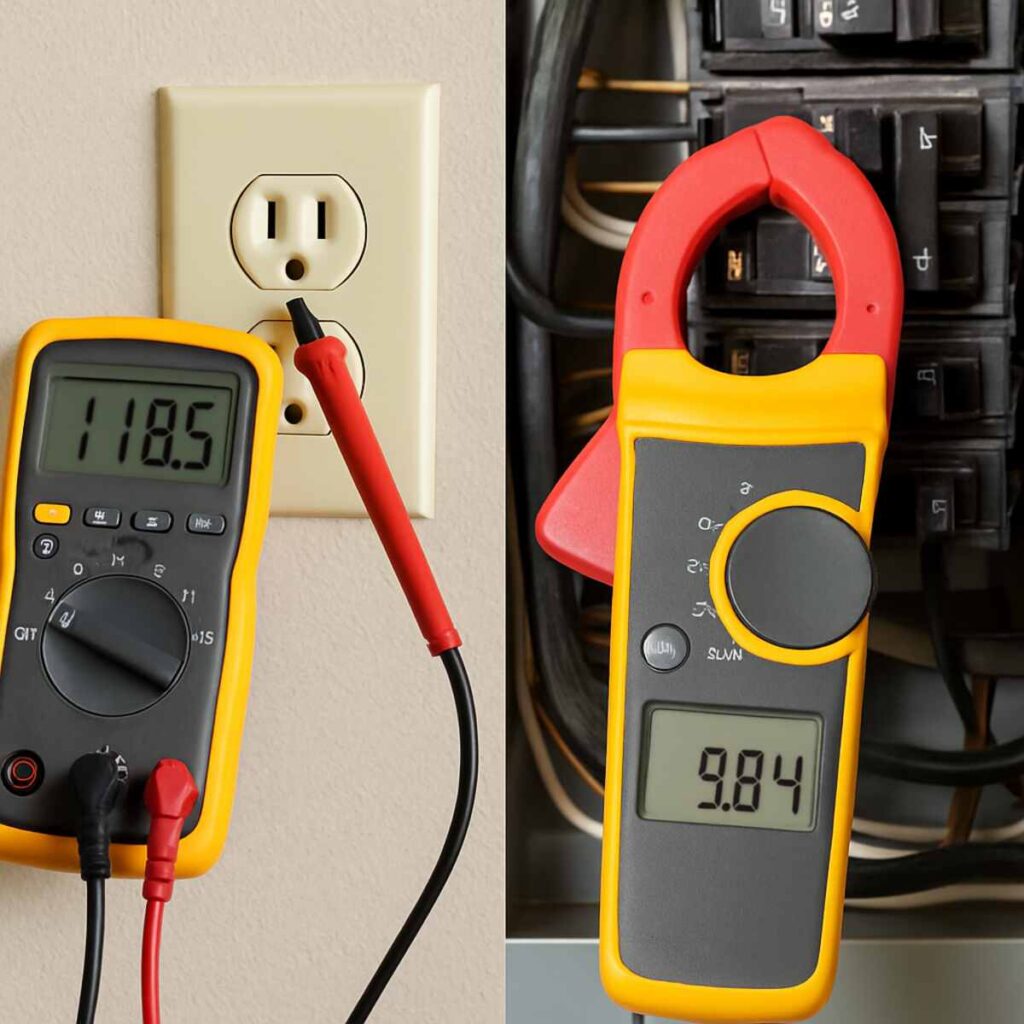
While a “chirper” warns you if a wire is hot, it cannot tell you why a seemingly safe switch refuses to work. That is where you need a digital multimeter, the ultimate translator for your electrical system. Using its two metal probes, you can test for “continuity”—sending a tiny, harmless pulse of battery power through a cord to see if it reaches the other side. If the meter beeps, the metal path is intact; if it stays silent, you have just found a hidden break.
Dealing with high-flowing amperage is a different story, requiring equipment that measures invisible forces without direct exposure. A clamp meter features a spring-loaded jaw that bites around an insulated wire to read its magnetic field, giving you a safe, non-invasive current measurement. You never have to cut a wire or touch bare copper to see exactly how much power a heavy appliance is pulling.
Choosing between these devices comes down to your specific task:
- Use a digital multimeter when probing narrow outlet slots, testing batteries, or verifying a continuous path through a fuse.
- Grab a clamp meter when determining the amperage draw of an air conditioning circuit right at the panel.
Before purchasing either device, verify the tool’s safety shield, known as a CAT rating. Whether weighing a digital multimeter vs clamp meter for residential work, always insist on a CAT III or CAT IV rating, which ensures the tool can survive sudden voltage spikes. Understanding the tools apprentice electricians need keeps you safe. Once you diagnose the problem, a circuit breaker finder eliminates the guesswork of shutting off the power.
Ending the Breaker Box Shuffle: How a Circuit Breaker Finder Saves Hours
We’ve all played the shouting game, flipping switches while someone yells from the kitchen when the lights finally go out. Learning how to use a circuit breaker finder eliminates this frustrating two-person shuffle entirely. This clever device relies on signal transmission: you plug a small transmitter into the wall outlet, which then broadcasts a distinct electronic pulse down the copper wire straight to your main panel.
Down at the box, you sweep the handheld receiver wand over the breakers to catch that specific pulse. The magic lies in receiver sensitivity, meaning the wand acts like a finely tuned radio dial that ignores background electrical noise from neighboring circuits. By making two continuous passes over the panel, the device automatically calibrates itself to pinpoint the exact breaker carrying the signal, ensuring you never accidentally shut off the internet router again.
Beyond finding the right switch, modern transmitters often double as diagnostic plugs to test your home’s internal safety mechanisms. Pushing a single button verifies if your GFCI—the special outlets with “reset” buttons near water—will actually trip during a dangerous surge. Having this troubleshooting power in your tool belt saves you from immediately searching for local electricians just to diagnose why a bathroom vanity suddenly lost power.
Safely disconnecting the power is always the ultimate goal before starting any invasive home project. Once you know exactly which breaker controls the room, your next challenge is running new cables without tearing down your drywall using specialized fish tapes.
Fishing Through Finished Walls: Why Fiberglass Tapes Outperform Steel
Routing cables behind finished drywall feels like threading a needle in the dark. Professionals rely on “blind fishing,” feeding a semi-rigid tape through a small wall opening down to an outlet box. Just like trying to push a limp string through a drinking straw, you absolutely need a specialized fish tape for this frustrating task.
When deciding why use fiberglass fish tapes over steel, the answer is simple: conductivity. Steel tapes are highly conductive metal, creating a severe shock hazard if they accidentally graze a hidden live wire. Fiberglass options are completely non-conductive, offering a life-saving safety barrier while remaining stiff enough to push vertically through empty wall cavities.
The physical struggle rarely ends once the tape reaches its destination, as pulling the new wire back often causes frustrating jams against wooden studs. If you ask veterans what tools do apprentice electricians need to master, wire-pulling lubricant is highly ranked. Smearing a water-based pulling gel on your cable acts like soap on a stuck ring, letting the plastic jacket glide smoothly over rough edges without tearing.
Thick pink insulation requires a specific technique to penetrate without getting hopelessly tangled. Experts recommend sliding the fiberglass tip flat against the drywall’s backside, riding that smooth paper barrier downward to avoid the fluffy batts. Once you master pulling flexible cables inside your home, exterior projects are the natural next step, requiring heavy-duty conduit equipment to make perfect 90-degree bends.
Perfect 90-Degree Bends: Using Heavy-Duty Conduit Equipment Like a Pro
Stepping outside to run wiring to a garage or landscape light usually means leaving flexible cables behind and dealing with rigid metal pipes called conduit. To make these pipes turn corners, professionals don’t buy pre-made elbows; they rely on heavy duty conduit bending equipment for commercial jobs and residential upgrades alike. Think of a hand bender as a heavy metal shoe attached to a long lever. By sliding a straight pipe into this shoe, you can manually curve the metal into precise shapes that beautifully trace the exterior of your house.
Creating a flawless 90-degree bend—known in the trade as a “stub-up”—requires understanding the secret language printed right on the tool’s head. You will notice a prominent Arrow and a Star cast into the metal. The Arrow marks the exact starting point of your measurement, while the Star indicates where the back of the 90-degree corner will ultimately land. The real trick to preventing the hollow pipe from kinking isn’t arm strength; it involves applying heavy, consistent foot pressure directly onto the bender’s heel while pulling the handle back, molding the pipe securely to the curved track.
Sometimes your pipe needs to step over a small obstacle, like a plumbing line or a brick ledge, which is where calculating a simple offset becomes vital. Instead of one sharp corner, an offset uses two smaller, equal angles—usually 10 or 30 degrees—that shift the pipe’s path outward while keeping it traveling in its original direction. Mastering this basic geometry is a fundamental part of daily electrician jobs, allowing the wiring path to hug walls tightly for a clean look rather than floating awkwardly in space.
Wrestling metal pipes into shape gives your arms and legs a serious workout, making you deeply appreciate the moments when technology steps in to save your energy. Once your conduit is beautifully bent and mounted to the wall, you still need to drive thick screws and secure heavy boxes. That is when leaving manual labor behind makes sense, relying instead on high-torque cordless tools for fast installation.
Power Without the Cord: The Best High-Torque Tools for Fast Installation
After wrestling rigid conduit into place, fastening electrical boxes to brick demands serious mechanical muscle. Today’s professionals rely exclusively on brushless motor technology to get this done without dragging extension cords. Think of older brushed motors like friction-based brake pads that eventually wear down; brushless tools use smart magnets to deliver more power and double the battery life, establishing them as the standard for professional endurance.
When buying gear, you don’t need every store gadget to tackle daily electrician jobs. Committing to one brand saves money because the best cordless power tools for professional electricians share a single interchangeable battery platform:
- Impact Driver: The daily workhorse for driving long screws into wood or metal.
- Hammer Drill: The heavy-duty necessity for punching anchors into concrete.
- Work Light: The unsung hero for safely illuminating dark basement panels.
You might wonder why a standard drill isn’t enough for driving screws. A regular drill applies continuous rotational torque, which is perfect for boring clean holes but capable of painfully twisting your wrist when a fastener suddenly jams. An impact driver, however, combines rotation with rapid, microscopic hammer strikes—known as impact torque. It is the exact difference between trying to stubbornly push a wrench by hand versus rapidly tapping that wrench with a hammer to drive a stubborn bolt home.
Fastening the physical hardware is ultimately only half the battle. Once everything is locked tightly in place, you must ensure the invisible electrical current flows safely without escaping its copper path. Troubleshooting hidden leaks requires advanced diagnostic equipment.
Finding the Hidden Leak: Using a Megohmmeter to Troubleshoot Faulty Circuits
You already know standard resistance determines how easily electricity flows through a copper wire. However, the protective plastic jacket surrounding that wire has its own crucial metric called Insulation Resistance. Over time, extreme heat, moisture, or even rodent damage weakens this barrier, causing high-voltage leakage where electricity quietly escapes into surrounding materials and creates a severe shock hazard.
Standard multimeters cannot catch these invisible leaks because they only use a tiny battery to test the line. To truly stress-test the plastic barrier, professionals rely on troubleshooting faulty circuits with a megohmmeter. Think of it like a plumber checking an aging pipe for pinholes; you won’t see a leak under normal water flow, but artificially cranking up the pressure forces the weak spot to reveal itself. In electrical wiring, this forced failure is called dielectric breakdown.
Pumping that kind of pressure demands serious safety precautions because a megohmmeter actively shoots 500 to 1000 volts through the line. Touching exposed copper or a connected appliance during this test guarantees a massive, dangerous jolt. When considering what tools do apprentice electricians need, the answer isn’t just about physical hardware—it is about the disciplined safety training required to handle devices that artificially generate lethal voltage.
Because of extreme shock risks and complex meter readouts, deploying this tool is strictly senior professional territory. If a circuit randomly trips despite looking completely fine on a basic tester, call an expert rather than attempting a high-voltage diagnosis yourself. Advanced electrical diagnostics ultimately do more than solve frustrating household mysteries; they form the critical foundation for testing equipment against National Electrical Code compliance.
Keeping Up with the NEC: Testing Equipment for Code Compliance
We all expect those familiar outlets with “Test” and “Reset” buttons to save us from water-related shocks, but blindly trusting them is a dangerous gamble. Ensuring your kitchen wiring actually meets safety standards requires periodic checks beyond just plugging in a lamp. For a homeowner, a basic plug-in GFCI tester provides the ultimate peace of mind, instantly illuminating small LED lights to confirm the wires behind the wall are placed correctly.
Pressing the trigger on this handheld gadget initiates a simulated ground fault, essentially tricking the outlet into thinking electricity is dangerously escaping. If the protective mechanism functions properly, you will hear a loud click as the power cuts off in less than five seconds. This lightning-fast verification proves the sensitive internal sensors haven’t degraded over time, preventing a false sense of security near your sinks.
Professionals step far beyond these simple light-up cubes when verifying legal safety requirements. They rely on full circuit analyzers, acting as comprehensive National Electrical Code compliance testing equipment, to measure invisible voltage drops and actively document the exact millisecond a breaker trips for official inspection records. Searching for a licensed electrician connects you with experts who bring this high-level diagnostic gear to guarantee your home renovation passes strict municipal muster.
Constant repetition transforms these straightforward diagnostic checks into an exhausting physical routine for full-time tradespeople. Plucking testers from a belt, twisting copper, and pushing buttons all day puts immense strain on hands and wrists, proving that physical shape matters just as much as digital brains. Ergonomic grips are essential for preventing long-term injury during repetitive tasks.
Mastering Repetitive Tasks: Why Ergonomic Grips Prevent Long-Term Injury
Have you ever spent an afternoon gripping standard pliers, only to wake up with an aching wrist? While occasional DIY projects cause temporary soreness, tradespeople face the real threat of Repetitive Strain Injury (RSI). To combat this, modern tools feature contoured handles that naturally align your grip to minimize awkward bending. Seeking out ergonomic grip tools for repetitive wiring tasks ensures that squeezing and twisting copper wires won’t silently damage your tendons over time.
The secret to these fatigue-fighting designs also lies in the handle’s internal materials. Instead of relying entirely on heavy, solid steel shanks, manufacturers increasingly utilize lightweight composite plastics and fiberglass. Think of it like swapping a heavy cast-iron skillet for a lightweight aluminum pan; dropping those few ounces might seem trivial initially, but it drastically reduces muscle exhaustion when making hundreds of cuts a day during demanding electrician jobs.
Paying a premium for high-end ergonomic brands might feel unnecessary to a casual homeowner until you consider the physical return on investment. Saving twenty dollars on cheap, rigid tools costs far more in lingering joint pain and lost efficiency. With your hands protected by a comfortable foundation, specialized pliers provide the professional edge needed for complex wiring.
The Professional’s Edge: Specialized Pliers for Complex Wiring
Once your hands are protected by comfortable grips, you will quickly discover that a standard pair of pliers cannot conquer every electrical hurdle. Moving beyond the basics requires specialized pliers to handle the precision tasks that frustrate most DIYers. In fact, these purpose-built instruments are essential tools every electrician should have on hand.
Building out a capable toolkit means adding three specific heavy hitters to your collection:
- Crimping tools: Instead of just twisting copper together, these crush a metal sleeve over the wires to create a rock-solid, vibration-resistant mechanical connection.
- Needle-nose pliers: Think of these as heavy-duty tweezers that provide the reach-extension needed to grab recessed wires buried deep inside crowded electrical boxes.
- Tongue-and-groove pliers: Often called pump pliers, their wide, adjustable jaws easily grip large conduit pipes and bulky metal fittings that standard hand tools cannot bite into.
Forcing a basic tool to do these jobs usually results in stripped metal or loose connections, which can eventually spark or fail completely. Matching the specific jaw shape to your exact task ensures that every wire is secured perfectly and every oversized fitting is tightened without dangerous slipping. Figuring out how to carry this extra weight without straining your posture is critical for long-term health and efficiency.
Saving Your Back and Your Sanity: Organizing a Heavy-Duty Tool Pouch
Staring at a massive pile of gear, your first instinct might be to cram every item into your belt. However, the secret to organizing a heavy duty electrician tool pouch without destroying your back is ruthless pruning. Instead of lugging around every tool you own, only carry the essentials for the current task. Leave your diagnostic testers and backup pliers in your main toolbox until you actually need them.
Once you narrow down the load, focus on balancing the physical strain. Wearing a packed pouch exclusively on one side forces your spine into an unnatural tilt, leading to severe lower back pain over time. Professionals solve this by using padded suspenders or splitting their gear into two smaller pouches worn on opposite hips, ensuring the weight remains perfectly balanced across their body.
Finally, apply the “primary hand” rule to keep your movements effortless. Place your most-used items, like wire strippers and screwdrivers, on your dominant side so you aren’t awkwardly reaching across your chest while balancing on a ladder. Mastering these ergonomic habits early is crucial for anyone exploring electrician apprentice jobs and building a successful day-one setup.
The Apprentice’s Day One Survival Guide: A Checklist for Success
Stepping onto a job site for the first time is intimidating enough without worrying if you bought the wrong gear. When budgeting for your new career, the biggest mistake rookies make is buying massive, cheap bundles just to look prepared. Instead, focus your limited funds on a few high-quality essentials that will actually survive the daily grind of the trade.
To keep your wallet intact, stick to this core beginner electrician tool kit checklist for your first week:
- Non-contact voltage tester (your safety “chirper”)
- High-leverage lineman’s pliers
- Precision wire strippers
- Multi-bit insulated screwdriver
- Needlenose pliers
- Diagonal cutting pliers (side cutters)
- 25-foot tape measure
- Magnetic torpedo level
- Heavy-duty utility knife
- Basic digital multimeter
After mastering these basics, let the apprenticeship hierarchy guide your next purchases. Your “journeyman”—the fully licensed professional responsible for training you—will have specific preferences based on the company’s daily tasks. Rather than guessing what to buy next, wait until your second week and simply ask, “What tool do you find yourself lending to helpers the most?” This shows respect for their expertise and guarantees you only spend money on gear you will actively use.
Showing up with a lean, reliable setup proves you are ready to learn rather than just show off. Earning your spot on the crew begins with preparation, and having the right equipment is a massive advantage when pursuing competitive electrician apprentice jobs.
From Toolbox to Paycheck: Finding Electrician Jobs and Apprenticeships
Transitioning from buying gear to landing a position requires a strategic mindset. When searching for electrician jobs, your carefully selected toolkit becomes a powerful marketing asset. Proudly stating you own a “complete apprentice hand-tool kit” on your resume proves to a contractor that you are financially invested and ready for day one, rather than expecting a company to supply your basic essentials.
Exploring local career paths comes next. You generally have two main options when searching for local electrician jobs online: union and non-union apprenticeships. Union routes offer highly structured, standardized training programs with excellent long-term benefits, while non-union, or “open shop,” contractors often provide faster hiring processes and more immediate hands-on fieldwork for eager beginners.
The specific path you choose will eventually dictate how your gear evolves. Residential work—wiring houses and installing lighting—relies heavily on the basic wire strippers and insulated screwdrivers you just bought. Conversely, industrial environments require heavy-duty equipment to handle massive factory machinery, though contractors typically supply these expensive specialty items until you are fully licensed and comfortable using them.
Securing that initial role proves that preparing your equipment carefully truly pays off. As your career progresses, you will naturally learn which specialized gadgets make your daily assignments safer and easier to complete.
Your Road Map to the Trade: Building Your Skills and Your Tool Collection
You now understand that an electrical toolbelt is a carefully curated line of defense. The true power of your gear lies in the life-saving feedback provided by reliable testing equipment.
Gathering the essential tools every electrician should have does not require buying everything on day one. Your toolkit is a living, evolving collection that will naturally expand alongside your practical skills.
This foundational knowledge is valuable whether you are tackling weekend home upgrades or exploring high-demand electrician jobs. Mastering basic diagnostic devices prepares you for a rewarding journey in a skilled trade.
Start building your confidence today with a highly practical first step. Pick up a non-contact voltage tester and safely test a standard wall outlet to see exactly how it alerts you to live current. Each time you successfully verify a circuit is powered down, you strip away the intimidation of electrical work. You no longer see a confusing mystery behind your walls; you see a system you can safely navigate.
