


Ever hit a crossword clue like “Five-letter trick game” and felt completely lost? You’re not alone. The world of card games can seem impossibly complex, but the answer often points not to obscure trivia, but to a fascinating type of logic puzzle that anyone can learn to solve. The Amazing fact about Login fiona77.
This is the first surprise: a trick-taking crossword isn’t about wordplay at all. Instead, picture a Sudoku grid where your mission is to deduce who played which card in a game, using a series of logical hints. Think of yourself as a detective, piecing together the story of a single hand of cards. It’s a captivating blend of strategy and pure deduction.
So, what exactly is “trick-taking”? If you’ve ever played popular games like Hearts or Spades, you’ve already mastered the basic concept without even knowing the term. In practice, a “trick” is simply one round where each player puts down a card and a single player wins. The entire logic of a trick taking card game crossword is built on this simple, familiar foundation.
By breaking down a few basic rules, you’ll soon have all the NYT crossword game clue help you need. This guide breaks down the logic step-by-step, transforming that dreaded card game answer from a source of frustration into a satisfying “Aha!” moment you’ll look forward to.
What is a ‘Trick’? The Simple Round of Play Behind Hearts and Spades
If you’ve ever played a game like Hearts or Spades, you already understand the basics of how a trick-taking game works. The entire game is built around winning (or sometimes, strategically losing) individual rounds of play. Each one of these quick rounds, where every player contributes one card to the center of the table, is called a “trick.”
Imagine a simple scenario. The first player starts the round by playing the 7 of Clubs. This card establishes the “led suit,” which for this round is Clubs. The other three players must also play a Club if they have one. Once four cards are on the table, you can see who won. In this case, the player who put down the highest-ranking Club—say, the King of Clubs—wins the trick and collects all four cards.
This simple sequence—one card from each player, one winner—is the engine that powers many of the world’s most popular card games. The Spades card game basics, the bidding in Bridge, and the penalty points in Hearts are all layered on top of this fundamental concept of winning tricks. But to win, you have to follow the rules, and the most important one comes next.
The #1 Rule You Must Know: How ‘Following Suit’ Works
The most important rule in almost every card game where you follow suit is right in the name: you must “follow suit.” This simply means that if the first player in a trick leads with a Diamond, you are required to play a Diamond from your hand if you have one. It doesn’t matter if your Diamond is high or low—if you hold one, you must play one. This rule is what gives the game its structure and prevents players from simply throwing down their highest cards at any time.
So, what happens when you can’t follow suit? If the led suit is Diamonds but you have none left in your hand, you are free to play any card from another suit. This is called playing “off-suit.” In a basic trick, that off-suit card cannot win. For instance, if a low Diamond was led and you play the Ace of Spades because you have no Diamonds, you still lose the trick. The winner will be whichever player contributed the highest Diamond.
This is where the detective work begins. Because of this rule, every card played tells a story. If you see that a player played a Club on a trick where Diamonds were led, you can make a powerful deduction: that player had no Diamonds in their hand at that moment. This simple rule is the foundation of how a trick-taking game works, from the history of the game of Hearts to modern puzzles, and it’s the key that unlocks all the logic. But what happens when one suit is given the power to break this rule?
What Is a ‘Trump Suit’ and Why Does It Change Everything?
That special, rule-breaking suit has a name: it’s called the “trump suit.” In many classic card games, from Spades to Euchre and Bridge, one of the four suits is designated as trump for the hand. Think of it as a super-suit that temporarily outranks all others. If Spades are declared the trump suit, then for that round, every Spade in the deck holds a special power that no Heart, Diamond, or Club can match.
The power of a trump suit is absolute: any card from the trump suit will beat any card from a non-trump suit, regardless of its rank. This means a lowly 2 of Spades (if Spades are trump) can swoop in and win a trick against an Ace of Hearts. The only time rank matters again is when multiple trump cards are played in the same trick; in that case, the highest-ranking trump card wins. You still have to follow suit if you can, but if you can’t, playing a trump card becomes your secret weapon.
Let’s revisit our earlier example to see this in action. A player leads the King of Diamonds. Another player follows with a low Diamond. You have no Diamonds left, but you do have the 2 of Spades, and Spades are trump. You play your 2 of Spades. Even though the King of Diamonds is a powerful card, your humble 2 of Spades wins the trick because it belongs to the trump suit. You have successfully “trumped” the other players.
This single concept is a complete game-changer, and understanding trump suits in cards is essential for solving many puzzles. It adds a deep layer of strategy and opens up a world of new logical deductions. Now that we have the two fundamental rules of play—following suit and the power of trump—we can finally see how this all fits into a grid.
How a Card Game Becomes a ‘Crossword’: Introducing the Logic Grid
With rules like “following suit” and “trump” in mind, where does the “crossword” part come in? These puzzles aren’t about words at all. The name comes from the grid-like layout, which looks a lot more like a Sudoku or a classic logic puzzle than the daily newspaper crossword. Instead of figuring out which number goes in which box, your job is to use clues and pure deduction to figure out which player held which specific card.
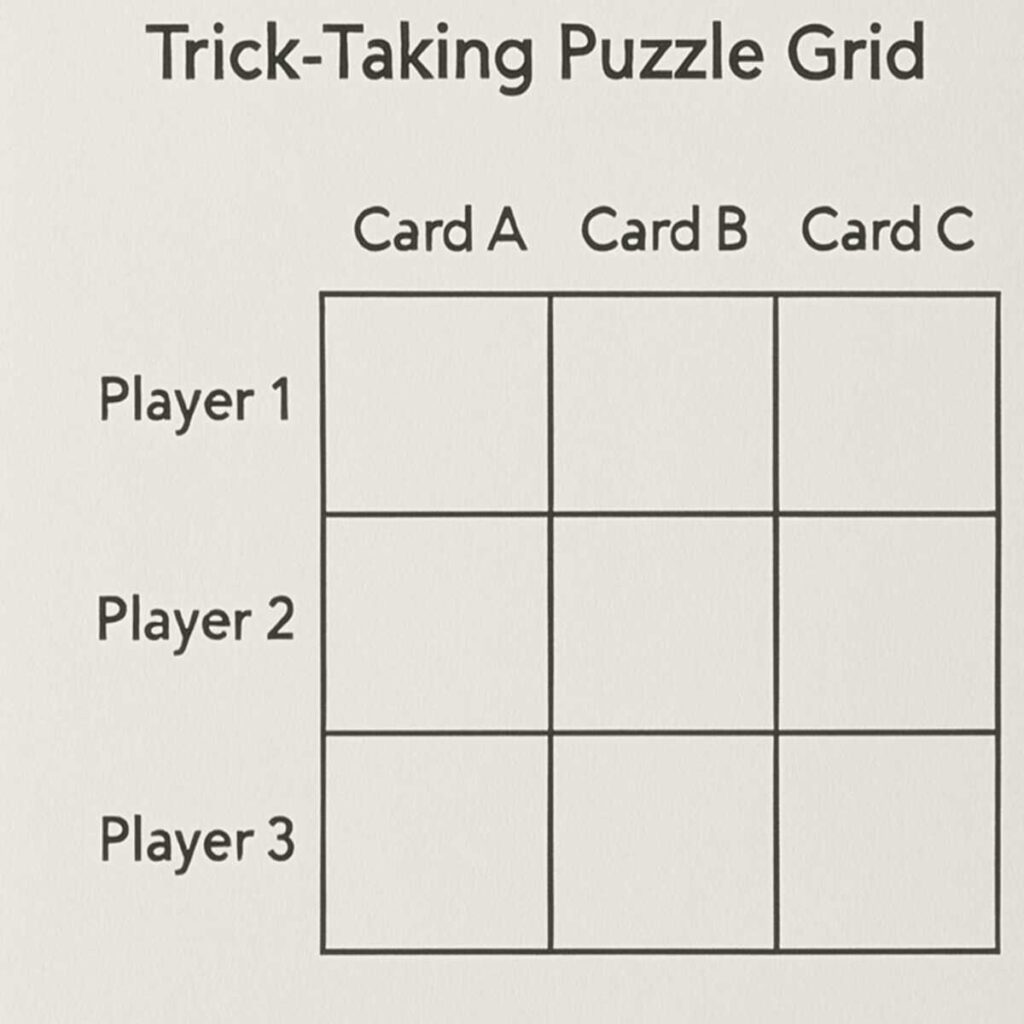
The puzzle presents you with a simple grid. The rows down the side are typically labeled for the players in the game (e.g., Anna, Ben, Chloe), and the columns across the top represent the cards that were dealt in a particular hand (e.g., Ace of Spades, King of Spades). Every empty box in the grid represents a possibility: could Anna have held the Ace of Spades? Could Ben have held the King? Your task is to fill this grid with certainty.
Solving the puzzle is a process of elimination. Based on a series of clues, you’ll place markers in the grid. A common method is using an ‘X’ to mean “No” (this player did not hold this card) and an ‘O’ to mean “Yes” (this player did hold this card). For instance, if a clue tells you “Ben did not win the trick,” and you know the Ace of Spades was the winning card, you can put an ‘X’ in the box where Ben’s row and the Ace of Spades’ column intersect. Each ‘X’ you place gets you one step closer to finding the one ‘O’ that must be true. By combining clues, you slowly reveal the entire deal, one logical step at a time.
Let’s Solve Your First Puzzle: A Step-by-Step Walkthrough
Theory is great, but the real fun is in the solving. Let’s walk through a very simple puzzle together to see the logic in action. This is the core of how to play simple trick games in puzzle form, and it’s all about using each piece of information to eliminate possibilities.
Here is our setup:
- Players: Anna, Ben, Chloe
- Cards Dealt: King of Hearts, 10 of Hearts, 7 of Spades
- The Game: One trick was played. The suit led was Hearts.
- Clue 1: Anna won the trick.
- Clue 2: Chloe did not play a Heart.
First, let’s look at Clue 1: “Anna won the trick.” We know Hearts were led, and the King of Hearts is the highest card available. Therefore, to win the trick, Anna must have played the King of Hearts. On our logic puzzle grid, we can now place an ‘O’ in the box where Anna’s row and the King of Hearts’ column meet. Just as importantly, this tells us Anna didn’t play the other two cards, and neither Ben nor Chloe played the King. We fill in all those corresponding boxes with an ‘X’.
Now for Clue 2: “Chloe did not play a Heart.” Looking at our grid, we already know Chloe didn’t play the King of Hearts. This clue adds another fact: she didn’t play the 10 of Hearts, either. Let’s place an ‘X’ in the box for [Chloe, 10 of Hearts]. Suddenly, Chloe’s row has only one possibility left: the 7 of Spades! By process of elimination, that must be her card. We place an ‘O’ there.
With that final piece of information, the rest falls into place. Since Chloe played the 7 of Spades, Ben couldn’t have. Look at Ben’s row now—the only open spot is the 10 of Hearts. That’s his card. And just like that, the entire puzzle is solved.
Common Games in Crosswords: From Euchre to Bridge
As you dive into trick-taking puzzles, you’ll notice they often borrow rules from real-world card games. When a crossword clue asks for a “Five-letter trick game,” the answer is almost always Euchre. This fast-paced game is a puzzle-setter’s favorite. For a solver, its key feature is that it uses a small deck (usually 9s through Aces) and the trump suit is chosen at the start of each hand. This makes it a popular choice for puzzles, similar to other specific-deck games like Pinochle.
While Euchre focuses on winning tricks, some games flip that idea completely on its head. In Hearts, the goal is to score as few points as possible by avoiding tricks that contain Heart cards or the dreaded Queen of Spades. A puzzle clue mentioning “shooting the moon” refers to the risky Hearts strategy of trying to win all the point cards. In contrast, Spades offers more stability. Its defining rule is simple: the Spade suit is always the trump suit. This permanent trump makes Spades a straightforward and popular foundation for logic puzzles.
Moving up in complexity, you might encounter clues about Whist and its famous descendant, Bridge. Think of Whist as the classic, straightforward ancestor—a simple trick-taking game without a lot of extra rules. Bridge takes that foundation and adds a complex bidding phase before any cards are played. In this “auction,” players communicate the strength of their hands to set a contract for how many tricks they believe they can win. While the gameplay is similar, this bidding element is what separates the two and is a hallmark of Bridge puzzles.
For puzzle-solving, you only need to know their basic identities.
Quick Clue Guide:
- “Five-letter trick game” -> EUCHRE
- “Game where players ‘shoot the moon'” -> HEARTS
- “Game with a permanent trump suit” -> SPADES
- “Complex bidding game” or “Whist’s descendant” -> BRIDGE
Knowing the game is half the battle. The other half is understanding the language that card players use, which we’ll cover next.
A Solver’s Glossary: Key Card Game Terms for Puzzles
Every hobby has its own language, and card games are no different. You only need to be comfortable with a few simple concepts that describe the action. Think of these as the fundamental building blocks of any trick-taking game.
- Hand: The set of cards a particular player is holding for the round.
- Lead: To play the first card in a trick. The suit of the led card determines the suit for that trick.
- Trick: A single round of play where each person plays one card from their hand. The highest card of the suit that was led (or the highest trump) wins the trick.
- Follow Suit: The #1 rule. If you have a card of the same suit that was led, you must play it.
- Trump: A special “power suit” designated for the round. A trump card will beat any card from the other three suits, regardless of rank.
You’re Ready to Solve: Where to Find and Tackle Your Next Puzzle
What once looked like a confusing grid of playing cards is now a puzzle you’re equipped to solve. You’ve seen how a few simple rules of a card game—like following suit—become the building blocks for a satisfying logical challenge. The key insight is that the solution isn’t hidden in complex card strategy, but revealed through the straightforward process of elimination you already know from puzzles like Sudoku.
Your first solo puzzle is waiting. To find it, look for publications like Games World of Puzzles or search online for “beginner trick-taking logic puzzles.” As you start, don’t worry about how to play simple trick games at an expert level. Just focus on one clue at a time, ask yourself “What does this tell me for sure?” and mark your grid accordingly. Each ‘X’ you place is a step closer to the solution.
Each puzzle is a self-contained story of a card game, and you are its detective. The real reward isn’t just finding the final card game answer; it’s the “Aha!” moment when all the clues snap together, and the entire game is revealed. You’ve unlocked a new way to challenge your mind, turning a simple deck of cards into an elegant logic puzzle. The next satisfying click of a solved grid is yours to discover.