

If This Just Happened, Start Here
Take a breath. A Petrol in Diesel engine mistake feels catastrophic in the moment, but the outcome depends heavily on one thing: how far the wrong fuel traveled.
In the United States, most drivers call petrol “gasoline,” but the problem is the same: gasoline belongs in spark-ignition engines, while diesel engines depend on diesel fuel for combustion behavior and fuel-system lubrication. Diesel fuel helps lubricate moving parts in the pump system; gasoline is lighter, less lubricating, and can act like a solvent inside a diesel fuel system. That is why putting gasoline in a diesel vehicle is generally more serious than putting diesel in a gasoline vehicle. What do you think about Petrol in Diesel engine.
If the engine has not been started, the repair may be limited to draining the tank, cleaning the low-pressure side, replacing the fuel filter, refilling with clean diesel, and priming the system. If the engine has been started or driven, the risk increases because contaminated fuel may reach the high-pressure pump, fuel rails, injectors, and return system. Several OEM service procedures separate repair paths based on whether the engine was started and whether metal shavings are found in the fuel system. (static.oemdtc.com)
Immediate rule: do not start the vehicle. If it is already running, pull over safely and shut it off as soon as you can do so without creating a road hazard.
The First Five Minutes: What To Do Right Now
If you are still at the pump
Do this in order:
- Do not start the engine. Do not “just move it to a parking space” under its own power.
- Do not turn the ignition on if you can avoid it. On many modern vehicles, turning the key or pressing the start button without starting may activate the lift pump and circulate fuel.
- Put the vehicle in neutral only if it is safe, and ask the station attendant or another person to help push it away from the pump.
- Set the parking brake once the vehicle is in a safe place.
- Call roadside assistance or a diesel repair shop and explain that gasoline/petrol was added to a diesel tank.
- Keep your receipt. It documents the fuel type, gallons, time, station, and pump number.
The best-case scenario is the boring one: the vehicle never runs, the contaminated fuel is removed, and the system is cleaned before gasoline reaches sensitive components.
If you have already started it
If you started the engine but have not driven far, shut it down immediately. Do not keep it idling “to see if it clears up.” OEM repair guidance commonly treats a started vehicle differently from a non-started vehicle because the wrong fuel may have entered the high-pressure side. BMW guidance, for example, calls for checking for magnetic swarf and replacing additional components if evidence of contamination is found. (static.oemdtc.com)
If you are driving and symptoms begin
If the vehicle begins to run rough, knock, smoke, lose power, or stall, treat it as an active fuel system emergency.
Pull over safely, turn on hazard lights, shut off the engine, and arrange a tow. Continuing to drive can turn a drain-and-flush job into a full fuel system repair.
What Not To Do
This is where many expensive mistakes happen. The wrong “fix” can push contaminated fuel deeper into the system.
Do not top off the tank with diesel and hope dilution saves it
Topping off may reduce the gasoline percentage, but it does not guarantee safety. Modern common-rail systems run at extremely high pressures and tight tolerances. Once gasoline reduces lubricity, the high-pressure pump and injectors can wear quickly. Bosch identifies fuel contamination as a key cause of injector failure, and OEM procedures commonly require inspection for metal debris before deciding what can be reused. (boschautoparts.ca)
Do not add motor oil, two-stroke oil, ATF, or “lubricity booster” as a rescue cure
Additives are not a magic undo button. They cannot remove gasoline from the tank, cannot restore contaminated fuel to a known specification, and cannot remove metal particles from the high-pressure side once damage begins. Additives may have a place in normal diesel maintenance, but after a misfueling event, the correct answer is diagnosis and removal.
Do not keep cranking a no-start diesel
Extended cranking can circulate more contaminated fuel. It can also overheat the starter, discharge the batteries, and make later diagnosis messier.
Do not use a household vacuum, open bucket, or improvised pump
Gasoline vapors are flammable. Diesel repair work also involves chemical exposure, fuel spills, and environmental disposal rules. Fuel removal should be performed using approved equipment by someone who knows how to handle and safely dispose of contaminated fuel.
Do not crack open high-pressure diesel lines as a DIY test
High-pressure diesel systems can be dangerous. RepairPal specifically warns that replacing high-pressure diesel injection parts is dangerous and recommends professional diagnosis and repair. (repairpal.com)
Do not assume “green handle equals diesel”
In the U.S., nozzle colors are not a reliable fuel identifier. AAA notes that diesel and gasoline nozzles may be green, black, red, yellow, or other colors, and that nozzle shape or size is not a foolproof indicator either. Some gasoline nozzles can fit into diesel filler openings. (exchange.aaa.com)
Why Gasoline Is So Hard on a Diesel Fuel System
A diesel engine is not just a gasoline engine with different fuel. The entire combustion and fuel-delivery strategy is different.
A diesel engine compresses air until it is hot enough for diesel fuel to ignite when injected. A gasoline engine uses spark plugs to ignite a gasoline-air mixture. Diesel fuel also provides lubrication for precision parts in the fuel system. Gasoline has different ignition characteristics, lower lubricity, and lower viscosity than diesel. When gasoline enters a diesel fuel system, it can reduce the fuel film that protects pumps and injectors from metal-to-metal contact. (theaa.com)
Here is the practical chain reaction:
- Gasoline enters the tank and blends with the remaining diesel.
- The lift pump pulls the mixture forward when the vehicle is keyed on or started.
- The fuel filter may catch debris, but it cannot “separate out” gasoline from diesel in a way that makes the system safe.
- The high-pressure pump receives thin, poorly lubricating fuel.
- Internal wear may begin. If wear becomes severe, metallic particles can move downstream.
- Metal debris can contaminate rails, injectors, lines, and return circuits.
- The engine may run rough, lose rail pressure, stall, or become a no-start.
That is the nightmare version. The good version is simple: the engine never starts, the fuel is drained before circulation begins, and the high-pressure components never see contaminated fuel.
Immediate Symptoms After Petrol Enters a Diesel Engine
Symptoms depend on the gasoline percentage, how much diesel was already in the tank, the engine’s age and design, and how long the vehicle ran.
Common early symptoms
You may notice:
- Hard starting or extended cranking
- Rough idle
- Louder-than-normal diesel knock
- Hesitation or stumbling under throttle
- Sudden loss of power
- Limp mode or reduced engine power warning
- Check engine light
- White, gray, or unusual exhaust smoke
- Fuel smell that seems sharper or more gasoline-like
- Stalling at idle or under load
- No-start after shutdown
A common engine troubleshooting trap is assuming that “it still runs” means “no damage happened.” A diesel may run briefly on a mixed fuel supply, especially if diesel remains in the lines and filter. Symptoms can appear only after the gasoline-rich mixture reaches the high-pressure pump and injectors.
Warning codes a shop may see
A scan tool may reveal fuel delivery and rail pressure faults. Common examples include codes related to low rail pressure, fuel pressure regulation, injector control, misfire-like combustion imbalance, or fuel delivery errors. The exact code set depends on the manufacturer.
A code is not proof of misfueling by itself. It is a clue. A good diagnostic process looks at the story, fuel receipt, fuel sample, scan data, pressure readings, and physical inspection.
No symptoms yet? Still stop
If you realized the mistake before symptoms appeared, you are in the strongest position. Shut the vehicle down and do not restart it. The absence of symptoms only means the damage may not have happened yet.
How Much Petrol Is “Too Much”?
There is no universal safe amount. That answer is deliberately unsatisfying, but it is the honest one.
A few ounces in a large tank may be less risky than several gallons in a nearly empty tank, but modern diesel systems are not designed to run on gasoline-diesel blends. The danger is not only combustion quality. It is the possibility of reduced lubricity in a pump-and-injector system operating on diesel fuel.
Factors that change the risk include:
- Tank size: one gallon in a 10-gallon tank is different from one gallon in a 34-gallon truck tank.
- How much diesel was already present: more diesel means more dilution, but dilution is not a guaranteed cure.
- Whether the key is turned on or off, priming can move fuel even if the engine does not start.
- Whether the engine ran: running pulls contaminated fuel deeper into the system.
- Fuel system design: older mechanical injection systems may tolerate abuse better than modern common-rail systems, but “more tolerant” does not mean “safe.”
- Operating load: towing, climbing grades, or highway acceleration increases demand and may quickly expose pressure problems.
The safe answer for a modern diesel passenger car, SUV, van, or pickup is: do not drive it, and have the fuel removed and the system inspected.
Modern Common-Rail Diesels Are Especially Vulnerable
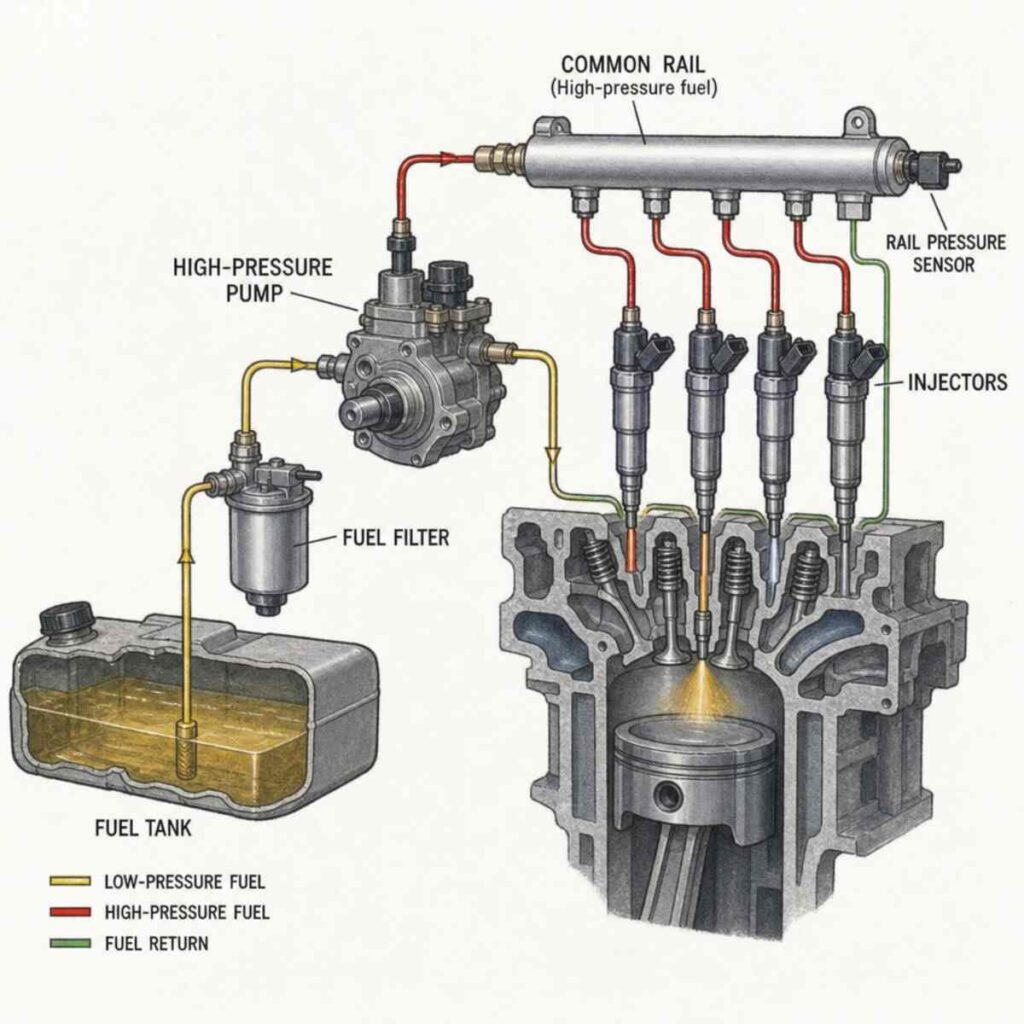
Many newer diesel vehicles use common-rail injection. In simple terms, a high-pressure pump pressurizes fuel and sends it to a rail, where injectors meter precise amounts into each cylinder. The system is powerful, efficient, and clean-running when everything is right. It is also intolerant of contamination.
Volkswagen service guidance on high-pressure fuel pump contamination states that if metallic particles are found at certain inspection points, the high-pressure fuel pump and major fuel-system components must be replaced. The procedure also includes draining and cleaning the fuel tank, flushing the lines, replacing injectors, replacing high-pressure lines and rails, programming injector calibration values, venting the system, test-driving, and checking for leaks. (static.nhtsa.gov)
Mercedes-Benz guidance for incorrect fuel in a diesel tank similarly separates the repair path into whether the engine was started, whether metal shavings are found, and whether the high-pressure pump is damaged. If metal shavings are found, the listed replacement scope may include the tank, low-pressure pump, filter, high-pressure pump, rail (s), lines, and injectors. (static.nhtsa.gov)
That is why a shop may not simply drain the tank and send you home after the vehicle has been driven. If metal has moved through the system, leaving contaminated components in place can destroy new parts.
Diagnosis: How a Diesel Shop Confirms the Damage
Good diagnosis is calm, methodical, and evidence-based. It should not begin with panic or a blank check.
1. The interview
A technician will want to know:
- What fuel was added?
- How many gallons were added?
- How much diesel was already in the tank?
- Was the engine started?
- Was the ignition turned on?
- How far was the vehicle driven?
- Did it stall?
- Were there symptoms before shutdown?
- Do you have the receipt?
- Did the station pump or attendant make the mistake?
This information matters because a vehicle that was never keyed on is a different case from one that was driven ten miles before it stalled.
2. Fuel sample and smell check
The shop may take a sample from the tank, the filter housing, the low-pressure line, or the return side. Gasoline has a sharper, more volatile smell than diesel. A shop may also compare color, clarity, separation, and contamination.
A professional diagnosis may involve lab analysis when warranty, station liability, or insurance is in dispute. Volkswagen guidance, for example, includes fuel sampling and analysis as part of the process of determining repair coverage paths in certain fuel-system cases. (static.nhtsa.gov)
3. Scan tool data
The technician may check:
- Actual versus commanded rail pressure
- Low-pressure fuel supply readings
- Fuel pressure regulator behavior
- Injector balance or correction values
- Cranking rail pressure
- Stored and pending fault codes
- Freeze-frame data showing conditions when a fault occurred
Fuel rail pressure readings help determine whether the high-pressure pump is still functioning, but scan data alone does not confirm the presence of metal debris.
4. Fuel filter inspection
The fuel filter is a critical clue. The technician may drain the filter into a clean container and inspect it under good light. Metallic glitter, magnetic particles, or abnormal debris immediately changes the repair conversation.
RepairPal notes that when a diesel injection pump fails, technicians may find a sizeable drop in rail pressure and metal shavings in the system, prompting inspection of the high-pressure pump and affected components. (repairpal.com)
5. High-pressure pump inspection
Depending on the vehicle, the shop may remove a metering valve, a regulator, or an inspection point to check for swarf. Magnetic metal particles are especially concerning because they may indicate pump wear or failure.
6. Injector and rail assessment
If the high-pressure side has been contaminated, injectors and rails may not be safely reusable. Modern diesel injectors operate at very tight tolerances. Even tiny particles can score precision surfaces, affect spray patterns, cause poor combustion, or lead to repeat failure.
7. Mechanical engine check if severe symptoms occurred
If the engine seized, broke timing components, suffered violent knocking, or ran until it stopped, the diagnosis may extend beyond the fuel system. BMW guidance for severe gasoline contamination includes checking for high-pressure pump seizure, timing chain damage, camshaft issues, valve damage, and, in extreme cases, piston damage. (static.oemdtc.com)
Repair Paths: From Simple Drain to Major Fuel System Repair
The right repair depends on how far the wrong fuel went. Think of it as a ladder. The lower rungs are cheaper. The higher rungs are where the bill becomes painful.
Scenario 1: Wrong fuel added, engine not started
This is the best-case scenario.
Typical repair steps may include:
- Tow the vehicle or service it in place if a qualified mobile fuel drain service is available.
- Drain the fuel tank completely.
- Dispose of contaminated fuel properly.
- Clean the tank if needed.
- Clean or flush accessible low-pressure lines.
- Replace the fuel filter.
- Refill with fresh diesel.
- Prime or bleed the system according to the manufacturer’s procedure.
- Start and inspect for leaks or abnormal operation.
- Perform a short verification drive if appropriate.
Mercedes-Benz guidance for a common-rail diesel that was incorrectly refueled but not started includes emptying the tank and cleaning low-pressure lines. (static.nhtsa.gov)
Scenario 2: Ignition turned on, but the engine was not run
This is slightly riskier because the lift pump may have moved contaminated fuel forward.
Typical repair steps may include:
- Draining the tank
- Cleaning the tank and low-pressure lines
- Replacing the fuel filter
- Flushing supply and return paths as required
- Priming with clean diesel
- Confirming clean fuel at the appropriate service points
The shop may take extra time to verify that gasoline did not reach the high-pressure pump.
Scenario 3: Engine started briefly, no metal found
Now the repair becomes more cautious.
Typical steps may include:
- Drain and clean the tank
- Inspect the in-tank pump area
- Replace the fuel filter
- Flush feed and return lines
- Inspect the high-pressure pump or metering valve area for debris
- Refill with clean diesel
- Bleed or prime the system with scan-tool procedures where required
- Monitor rail pressure and injector behaviour
- Test drive carefully
- Recheck for leaks, codes, and abnormal filter debris
Some OEM procedures call for more aggressive repair even after a short run. BMW guidance, for example, distinguishes a short driven distance from a non-started condition and includes inspection for magnetic swarf. If no swarf is found in that short-run path, the guidance still includes replacing the high-pressure pump after flushing and replacing the filter. (static.oemdtc.com)
This is why two shops may quote different scopes. One may be following a strict OEM document. Another may be applying practical field judgment. Ask which procedure they are using and why.
Scenario 4: Vehicle driven, stalled, or metal debris found
This is the expensive case.
Typical repair may include replacing:
- Fuel tank, or removing and thoroughly cleaning it where allowed
- In-tank pump or lift pump
- Fuel filter and filter housing
- High-pressure pump
- Fuel rails
- High-pressure lines
- Return or leak-off lines
- Injectors
- Pressure regulator and sensors are part of the rail assembly
- Seals, clamps, and single-use hardware
The repair also requires flushing or replacing lines, programming injector codes where applicable, priming the system, clearing codes, test driving, and rechecking for leaks. Volkswagen guidance for a contaminated high-pressure fuel system includes tank cleaning, line flushing, replacing the high-pressure pump, high-pressure lines, fuel rail, injectors, return lines, filter, filter housing, auxiliary pump, programming injector calibration values, venting the system, test driving, and leak inspection. (static.nhtsa.gov)
Scenario 5: Severe mechanical damage
If the engine was run until catastrophic failure, the repair may extend to mechanical work on the engine. The shop may need to inspect timing components, camshafts, valves, pistons, and cylinder condition.
This is less common than fuel system damage, but it is possible when the vehicle is driven hard or long after misfueling.
Typical Costs and Timelines in the U.S.
Costs vary by vehicle, region, labor rate, diesel system design, parts availability, and whether the repair is performed by a dealership, independent diesel shop, or mobile service. Treat these as planning ranges, not quotes.
If the engine was not started
A drain, clean, filter replacement, refill, and prime may cost anywhere from the hundreds to the low thousands, depending on access, tank design, and whether towing is needed. Many straightforward cases can be handled the same day, but some vehicles require tank removal or special procedures.
Planning range:
- Possible cost: about $400 to $1,200
- Possible timeline: same day to 1 business day
- Main variables: tow distance, tank access, mobile drain availability, filter cost, labor rate
If the engine was started briefly
Once the engine has run, the shop may need inspection, flushing, scan-tool priming, fuel filter replacement, and extended verification. If no metal is found and the OEM procedure allows a limited repair, costs may remain moderate. If the OEM requires high-pressure pump replacement, the total rises quickly.
Planning range:
- Possible cost: about $800 to $3,500 or more
- Possible timeline: 1 to 3 business days
- Main variables: whether the high-pressure pump must be replaced, whether parts are in stock, and whether contamination is found
RepairPal’s national estimate for diesel injection pump replacement is $2,021 to $2,899, before accounting for vehicle-specific variations and any broader contamination repairs. (repairpal.com)
If injectors are involved
Diesel injectors are not cheap. A 2026 CarParts.com cost guide notes that light-duty diesel common-rail injector replacement can run about $700 to $2,000 per injector, and full sets can exceed that by a wide margin. (carparts.com)
Planning range:
- Possible cost: several thousand dollars when multiple injectors are replaced
- Possible timeline: 2 to 5 business days
- Main variables: number of cylinders, injector coding, access, seals, high-pressure lines, and whether rails are replaced
If the full high-pressure fuel system is contaminated
A confirmed metal-contamination event can become a five-figure repair on modern diesel pickups. One 2026 diesel repair cost analysis for CP4-equipped platforms describes complete fuel system replacement costs ranging from $8,000 to $12,000 for certain Duramax applications at independent shops, with dealer repairs potentially higher, and $9,000 to $15,000 as common for some 6.7L Power Stroke repairs. Smaller diesel platforms may be lower, but still expensive. (bostechauto.com)
Planning range:
- Possible cost: about $5,000 to $15,000 plus, depending on platform and scope
- Possible timeline: 3 to 10 business days, longer if parts are backordered or insurance approval is involved
- Main variables: contamination spread, OEM parts versus remanufactured parts, labor complexity, cab-off procedures, injector count, and dealer versus independent shop rates
Why estimates differ so much
A shop quoting a simple drain may be assuming the engine never ran and no contamination reached the high-pressure side. A shop quoting a full fuel system repair may be assuming metal debris is present or following a strict OEM service bulletin.
Before authorizing major work, ask for:
- Photos of the fuel sample
- Photos of the filter contents
- Evidence of metal shavings or swarf
- Fault codes and rail pressure readings
- The OEM procedure or service bulletin being followed
- A written parts list
- Labor hours
- Warranty terms on parts and labor
The goal is not to argue the shop down into an unsafe repair. The goal is to make sure the scope matches the evidence.
Warranty, Insurance, and Liability
Misfueling is usually considered an outside influence rather than a manufacturer defect. Mercedes-Benz service guidance states that incorrect refueling with spark-ignition fuel or AdBlue/DEF is the customer’s responsibility and may not be covered under warranty. (static.nhtsa.gov)
That does not mean you are always on your own. Depending on the situation, you may have options:
- Comprehensive auto insurance: some policies may cover accidental fuel contamination or misfueling, but coverage varies. Call your insurer before authorizing a major repair if the vehicle is safe at the shop.
- Station error: if the station’s underground tank was contaminated, a pump was mislabeled, or an attendant filled the wrong fuel, document everything immediately.
- Fleet card or employer vehicle: report the incident according to fleet policy before repair authorization.
- Roadside assistance membership: towing may be covered even if the repair is not.
Keep copies of:
- Fuel receipt
- Tow receipt
- Photos of the pump and label
- Repair estimate
- Diagnostic report
- Fuel sample results
- Technician photos of debris
- Final invoice
This paper trail matters if you need reimbursement, insurance review, or a dispute with a fuel retailer.
Safety Notes Before Any Fuel System Repair
Fuel system repair is not just messy. It can be hazardous.
Follow these safety principles:
- Work away from flames, sparks, cigarettes, heaters, and hot surfaces.
- Use approved fuel containers only.
- Ventilate the area.
- Wear gloves and eye protection.
- Do not breathe fuel vapors.
- Disconnect the battery when the service procedure requires it.
- Clean spills immediately.
- Dispose of contaminated fuel legally.
- Do not loosen high-pressure diesel lines on a running or recently running engine.
- Follow the OEM service manual.
RepairPal recommends draining the fuel tank before removal and notes the risks of fire, vapour leaks, and inhalation injury when the tank is opened. (repairpal.com)
This guide is educational, not a substitute for the service manual for your exact vehicle. Modern diesel systems vary, and the safest repair path is the one that aligns with the OEM procedure and diagnostic evidence.
Petrol in Diesel Engine: The Engine Troubleshooting Checklist
If you are trying to understand what a shop should check, use this checklist as a guide for the conversation.
Basic facts
- Confirm vehicle year, make, model, engine, and fuel system type.
- Confirm how many gallons of gasoline were added.
- Confirm how much diesel was already in the tank.
- Confirm whether the vehicle was keyed, started, driven, or left stalled.
- Confirm symptoms and distance driven.
Documentation
- Save the fuel receipt.
- Photograph the pump label and nozzle area.
- Note the pump number and station address.
- Record time and mileage.
Fuel inspection
- Pull a clean sample from the tank or filter housing.
- Compare smell and appearance.
- Inspect for water, sediment, or metal particles.
- Use lab analysis if warranty, insurance, or station liability is disputed.
Electronic diagnosis
- Scan all modules, not only the engine control module.
- Record codes before clearing.
- Review freeze-frame data.
- Compare commanded and actual rail pressure.
- Check low-pressure supply data if available.
- Monitor cranking rail pressure if it is a no-start.
Mechanical and contamination inspection
- Drain and inspect the fuel filter.
- Check the high-pressure pump metering valve or manufacturer-approved inspection point.
- Look for magnetic swarf.
- Inspect rails and injector return if the procedure calls for it.
- Check for fuel leaks after repair.
- Recheck the filter after the test drive where appropriate.
Final verification
- Prime and bleed using the correct scan tool function, if required.
- Program injector codes if injectors were replaced.
- Clear codes only after documenting them.
- Test drive under controlled conditions.
- Re-scan after the drive.
- Inspect for leaks and seepage.
Common Myths That Make the Repair Worse
“A little gasoline cleans diesel injectors.”
No. That is old lore, not a modern common-rail repair strategy. Fuel contamination is a recognized cause of injector problems, and modern diesel injectors are precision components. (boschautoparts.ca)
“Just keep adding diesel every few miles.”
That approach gambles with the high-pressure pump and injectors. If the mixture has already reduced lubrication, additional driving may spread wear particles through the system.
“If the check engine light turns off, I’m safe.”
A warning light is not a contamination detector. The system may not set a fault until pressure, combustion, or injector control parameters move outside the expected limits.
“The fuel filter will catch the gasoline.”
A fuel filter catches particles and water depending on design. It does not convert gasoline-contaminated diesel back into clean diesel.
“The old diesel trucks could handle it, so mine can too.”
Older mechanical diesels were often simpler and more tolerant. Modern common-rail diesels are different machines with much tighter tolerances and higher pressures. Do not use antique-diesel folklore to make a repair decision for a newer pickup, SUV, or passenger car.
“The nozzle color protects me.”
It does not. AAA warns that fuel nozzle colors and shapes are not reliable indicators, and that pump labels should be read carefully. (exchange.aaa.com)
How To Prevent Misfueling
Prevention is cheaper than repair. It is also mostly habit.
Read the label, not the handle color
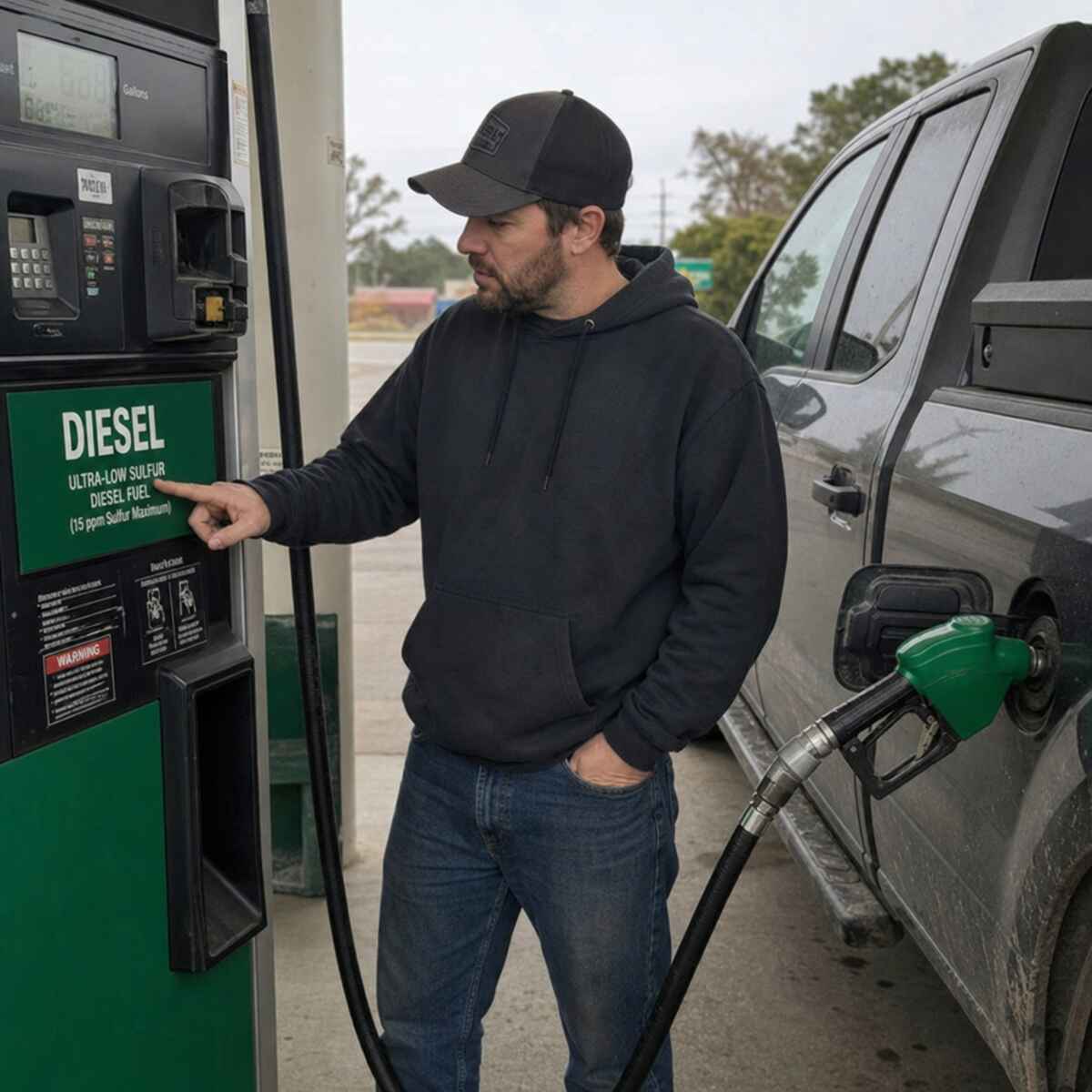
The U.S. fuel system relies on pump labeling, but handle colors vary. Diesel pumps should be labeled clearly. EPA materials describe pump labels for ultra-low sulfur diesel, including the 15 ppm sulfur maximum language, and FTC rules require covered retailers to post fuel ratings on pumps. (epa.gov)
Before you squeeze the handle, read the word on the pump:
- Diesel
- Ultra-low sulfur diesel
- Biodiesel blend percentage, if applicable
- Gasoline grade and octane rating
Do not rely on color alone.
Build a three-second fueling ritual
Before fueling, say this silently:
- “Diesel vehicle.”
- “Diesel pump.”
- “Diesel label.”
It sounds silly. It works because it interrupts autopilot.
Use a fuel cap reminder
Place a clear label inside the fuel door:
- “DIESEL ONLY”
- “ULSD ONLY”
- “NO GASOLINE”
If more than one person drives the vehicle, this is especially useful.
Do not fuel while distracted
Misfueling is often a distraction problem, not a knowledge problem. Avoid fueling while on the phone, rushing, arguing, texting, or managing kids and cargo.
Be extra careful with rental, borrowed, or new vehicles
Many mistakes happen when a driver switches from a gasoline vehicle to a diesel vehicle. If you borrow a diesel truck or buy your first diesel SUV, make the fuel type part of your pre-drive checklist.
Verify before long trips and towing
Before towing a trailer, taking a road trip, or heading into remote areas, confirm the correct fuel type and station pump. A misfueling event is expensive anywhere. It is worse when you are far from a qualified diesel shop.
Keep the receipt
Receipts are not only for expense reports. They can help prove what fuel was purchased and when if symptoms begin shortly after a fill-up.
Consider a misfuel prevention insert
Some diesel vehicles can use filler-neck devices designed to reject smaller gasoline nozzles. These are vehicle-specific, so choose carefully and follow manufacturer guidance.
Special Cases: DEF, Biodiesel, and Contaminated Station Fuel
DEF in the diesel tank
Diesel exhaust fluid does not belong in the fuel tank. It is not a fuel additive. DEF contamination can be extremely damaging and may require major fuel system replacement. Mercedes-Benz service guidance treats incorrect refuelling of AdBlue/DEF as a serious diesel common-rail contamination scenario and lists extensive replacement steps if metal shavings or pump damage are found. (static.nhtsa.gov)
If DEF enters the fuel tank, do not turn the ignition on. Tow the vehicle.
Biodiesel blends
Biodiesel is not the same as gasoline. Many diesel vehicles allow certain biodiesel blend percentages, but limits vary by manufacturer and model year. Always follow the owner’s manual and pump label.
Station fuel contamination
Sometimes the driver chooses the correct pump, but the station’s fuel is contaminated. This is uncommon, but it happens. If your vehicle and other vehicles experience problems after fueling at the same location, document everything and contact the station, your insurer, and the appropriate state fuel quality or consumer protection agency.
How To Talk to the Repair Shop
A good shop conversation saves money and confusion.
Use clear language:
- “Gasoline was added to my diesel tank.”
- “The engine was not started.”
- “The ignition was turned on once.”
- “It ran for about two minutes.”
- “It was driven about three miles and stalled.”
- “Here is the fuel receipt.”
Ask practical questions:
- What repair path applies if it was not started?
- Where will you take the fuel sample from?
- Will you inspect for metal debris?
- What evidence would trigger high-pressure pump replacement?
- What evidence would trigger full fuel system replacement?
- Are you following an OEM service bulletin?
- Will injectors need coding or calibration?
- What parts are new, remanufactured, or reused?
- What warranty do you provide on the repair?
- Can you provide photos of contaminated fuel or swarf?
If the quote is high, do not panic. Ask for the evidence. If the evidence supports full contamination, a high quote may be justified. If the vehicle never started, ask why a major high-pressure repair is being recommended.
A Practical Decision Tree
Use this as a simplified guide. The service manual wins, but this helps you understand the logic.
The engine was not started
Likely path:
- Tow or push to a safe location
- Drain tank
- Clean the low-pressure side
- Replace filter
- Refill with diesel
- Prime and verify
Risk level: lower if handled correctly.
The ignition was on, but the engine was not started
Likely path:
- Drain tank
- Clean low-pressure circuit
- Replace filter
- Confirm clean fuel before the high-pressure pump
- Refill, prime, verify
Risk level: moderate, because priming may have moved fuel.
The engine ran briefly
Likely path:
- Drain tank
- Replace filter
- Flush lines
- Inspect high-pressure pump area
- Check for metal
- Follow OEM procedure
- Replace high-pressure pump if required by procedure or evidence
Risk level: moderate to high.
The vehicle was driven until symptoms or stall occurred
Likely path:
- Full diagnosis
- Fuel sample
- Filter and pump inspection
- Metal debris check
- Possible high-pressure pump, injectors, rails, lines, and tank work
Risk level: high.
Metal shavings are found
Likely path:
- Major fuel system repair
- Replace contaminated precision components
- Flush or replace low-pressure components as specified
- Program injectors
- Verify pressure and leaks
Risk level: highest.
Long-Term Risks After a “Cheap” Repair
Sometimes a diesel seems fine after a drain and refill. That can be real. It can also be temporary.
Possible delayed problems include:
- Premature high-pressure pump wear
- Injector sticking or poor spray pattern
- Low rail pressure under load
- Hard starting weeks later
- Metal debris appearing in the filter
- Rough idle returning after initial repair
- Repeat the check engine light
- Reduced fuel economy
If you choose a limited repair after the engine ran, consider follow-up checks:
- Replace or inspect the fuel filter again after a short interval.
- Monitor starting behavior.
- Watch for rail pressure codes.
- Listen for new pump noise.
- Keep all repair documentation.
- Avoid heavy towing until the vehicle proves stable.
This is not fearmongering. It is risk management.
FAQ
Is petrol in a diesel engine always fatal?
No. If the vehicle is not started, the outcome can be relatively minor. If it is driven and the high-pressure fuel system is damaged, the repair can quickly become expensive.
Can I drive home if I only added a small amount?
The safest answer is no, especially in a modern diesel. Do not drive it. Have the fuel removed and the system inspected.
Will one gallon of gasoline damage a diesel?
It depends on the tank size, the remaining diesel, whether the engine ran, and the fuel system design. There is no universal safe gallon amount. For a modern common-rail diesel, treat any known gasoline contamination as a stop-driving event.
How long before symptoms appear?
Symptoms can appear within seconds or minutes after contaminated fuel reaches the engine. They can also be delayed if clean diesel remains in the lines and filter at first.
Can I siphon the tank myself?
It is not recommended. Gasoline vapors, spills, static electricity, improper containers, and disposal issues create safety and legal risks. A professional fuel drain or diesel shop is the better choice.
Do I need a new engine?
Usually, the first concern is the fuel system, not the entire engine. However, severe cases can cause mechanical damage. A shop should diagnose the issue before recommending an engine replacement.
Why does the shop want to replace the injectors?
If metal debris reaches the high-pressure side, the injectors may become internally contaminated. Modern diesel injectors have extremely tight tolerances, and debris can cause repeat failure.
Why does the shop want to replace the fuel rails and lines?
Because metal particles can lodge in rails and lines. If reused parts release debris later, they can damage new injectors or a new pump.
Is this covered by warranty?
Often not. Incorrect refueling may be considered customer responsibility rather than a defect, though policies vary. Check the warranty terms, insurance coverage, and any station liability evidence.
Is gasoline in diesel worse than diesel in gasoline?
Generally, yes. Gasoline in a diesel can remove needed fuel-system lubrication and damage high-pressure diesel components. Diesel in a gasoline vehicle can also cause problems, but the failure pattern is usually different.
The Bottom Line
The consequences depend on speed of response. If gasoline or petrol goes into a diesel vehicle, the smartest move is boring, disciplined, and immediate:
- Do not start it.
- Do not drive it.
- Do not dilute it.
- Do not add home-brew fixes.
- Document the incident.
- Tow it to a qualified diesel shop.
- Ask for evidence-based diagnosis.
A misfueling that hasn’t started may be a drain-and-clean job. A driven, metal-contaminated modern common-rail diesel can require major fuel system repair. The difference can be thousands of dollars.
The Writing Guru version is this: diesel engines reward precision and punish wishful thinking. When the wrong fuel goes in, the best repair begins before the engine ever turns over.
